Google Analytics

"... side by side with the human race runs another race of beings, the inhuman ones, the race of artists who guided by unknown impulses, take the lifeless mass of humanity and by the fever and ferment with which they imbue it turn this soggy dough into bread and the bread into wine and the wine into song..."
Henry Miller

Inventing a New Way to Listen to Music

This blog aims to expand your appreciation for song and written word together. Many of the posts have been designed to match the time of a specific song in reading length. The words of the post, together with the song you hear, will open your mind to a new way of reading and listening to music. Enjoy!

Monday, November 29, 2010

What is a Hipster?


For those of you who frequently check in with the inhuman ones, I apologize for my recent lack of content. I could spend the next 50 words griping about why I am unable to get anything up on this blog right now, but I will save you the pathetic self-pity.

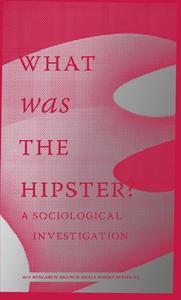
Last week, I read a book that is being sold out all over in New York City titled "What Was the Hipster?" The book is a follow-up to a panel/academic conference held at The New School in April 2009 and was coedited by Professor Mark Greif. Mark is an amazing cat--he did his undergrad in literature and history at Harvard, Master's at Oxford, and got his Ph.D. in literature from Yale.

I sat down with Mark to interview him on hipster culture and we had a very interesting conversation. The book is so good, it inspired me to abandon one of my research topics here in my final semester to take up trying to answer the following question that has puzzled me about hipsters: "Why is this the one (or at least, first) subcultural movements of which its members wish to deny being a part of?"

Being called a "hipster" is an insult to most. The Onion captured it best in a witty article heading; "Two Hipsters Angrily Call Each Other 'Hipster'." Hipster culture is a fascinating topic to me and this week's Book Talk on BreakThru Radio was the best show yet.

I implore you all to take some time (the show is 60 minutes in length) and listen to Mark discuss what he and his co-researchers have discovered about hipsters in 2010 (especially if you deny being in the category yourself--this means you and all your hipster friends Eugenia). And, if you like what you hear, go and buy his book ("What Was the Hipster?").

Click HERE for the show.

Tuesday, November 23, 2010

Facebook Privacy: The Canary In The Coal Mine

For anyone who uses Facebook (in other words, all of you), you should really check this article and 3-minute video done by one of our staff who also works for The Huffington Post.

This shizzle is real; and scary as hell!

Facebook Privacy: The Canary In The Coal Mine

Wednesday, November 17, 2010

If There’s No Father to His Style, Call Him ‘Bastard’


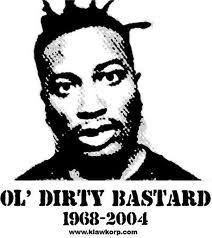
“To the public he was known as Ol’ Dirty Bastard but to me he was known as Rusty. The kindest, most generous soul on earth."

Cherry Jones, mother of ODB

This past Saturday (November 13) marks the sixth-year anniversary of the death of Russell Tyrone Jones, the rapper more famously known as Ol’ Dirty Bastard. Strangely enough, on this past Monday (November 15) he would have been 42.

It is a daunting task to try and write a thousand-word obituary on a man one hardly knows anything about. Sure, I remember playing basketball to Wu Tang Clan tracks when I was in high school; but that was only as a result of high pressure and a lot of persistence from a very close friend of mine who demanded his hip-hop CDs get as much play time as my overdone, and inappropriate in comparison, classic rock repertoire. It was not long before I began to recognize my own closeted affection for the Staten Island collective. Soon thereafter, and much to the surprise of my good pal Chris, I was requesting the Clan each time we got into his truck to head off to football practice, drink rye and gingers at a bush party, or cruise the ‘dangerous’ redneck streets of my hometown. What was this kung-fu stuff? I didn’t have a clue, and I didn't really much care.

What I did know was narrowed down to two indisputable certainties: 1) I had no idea what this guy was rapping about, and couldn’t relate to any of it. And 2) It didn’t matter, because "oh baby," I too, “like it raw.”


The thing about a guy who comes onto the scene under the moniker ‘Ol’ Dirty Bastard’, and backed by a group called ‘The Wu Tang Clan’, you would assume presents an immediate problem to his listeners. And while for a while, I felt guilty for once thinking this way, the more I learn about ODB, the less guilt I feel. Shock was his modus operandi--the idea that people didn't understand him, but stopped to look and listen anyhow, was exactly the entertainment value he was trying to achieve. It was a style that would separate him from just about all of his contemporaries. I speculate that the reaction I got from his music was the very response he was looking for. He wanted his audience to hear his music and watch his performances in a “what the fuck just happened” state of disbelief.

A case in point (his most famous case, to be exact):

During the fortieth Grammy award ceremonies (1998) in Rockefeller Plaza, Dirty jumped onto the stage to interrupt the “song of the year” recipient speech in a state of full- consciousness of what he was doing. His intention became his desired result. You see, in 1998 the Grammy’s had still not recognized the rap-portion of the show as a television worthy event; and this pissed Dirty off. Frustrated that the awards for hip-hop artists were handed out a day earlier, during a non-televised ceremony, ODB took advantage of this moment to share with the rest of the country his sentiments for the injustices of a biased music industry. While many viewers saw it as a form of “distaste,” others applauded Dirty for his stance against racial prejudices in a country and industry that is supposed to be a leader in the disintegration of exactly that. In 1998, were organizers and leaders in the American Music Academy really that much in the dark about a genre of music that was over two-decades old and, by then, deeply immersed in American culture? If so, Dirty sure rattled them to attention.

A lot can be said about the life of Russell Tyrone Jackson that this article does not have the time nor space for. (As a side not, if you are interested I suggest Digging for Dirt: The Life and Death of ODB by Jaime Lowe, which was the primary research source for this article). I could have spent much of my time filling you in on all of his sexual escapades that led to fatherless and unsupported children. I could have gone into detail over his trouble with the law, time spent in and out of US’s notorious and discriminatory prison system, and the somewhat lengthy criminal record he managed to acquire over his thirty-five years in this world. Finally, I could have discussed his personal battle with drug and alcohol abuse, supposed and much disputed mental instability, and the official cause of his death: “Accidental overdose from a lethal combination of Tramadol [a painkiller] and cocaine.” But none of this gets down to the core of the man known as Ol’ Dirty Bastard.

Time is the ultimate equalizer. The further we move away from nineties hip-hop, the more we come to recognize it as a major player to a much greater subversive trend. What we often fall guilty of when thinking about these acts of subversion is that it is individual ‘people’ who make the parts to these cultural shifts; they don't just happen on themselves. Ol’ Dirty Bastard was one of those people. In other words, while our language is mostly predicated on the idea that ‘hip-hop’ now stands alone as a viable, sustainable American culture, independent from other subcultures like country, punk, indie, metal, etc., we should be thinking about the people that made it this way. It wasn’t some anomaly born out of thin air. It was a culture built on the character and styles of artists and performers like Russell Jackson.

Alas, forget my self-prescribed verbose haughtiness. It is said much better in the vernacular of the culture:

“What’s the world without Dirt? Just a bunch of fuckin’ water.” Rhymefest


Wednesday, November 10, 2010

Inverted Ballet

I am not sure how many of you are aware, but there is a new ballet running in San Francisco that is choreographed entirely to music by The Shins. It has been playing for about five weeks now and has received some fairly strong reviews. This is precisely the cross-fertilization of traditional music genres I am glad to see these days. Despite my personal disdain for ballet, I admire anytime musicians and choreographers seek to remove the limits of what is expected in separated music mediums.

As for me, my interest in this particular crossover can be tied to the fact that it involves: a) a band I happen to like very much; and b) a form of musical representation in which I really have no time for. So I wonder which of the two will dominate my subjectivity to taste? I also wonder: Why The Shins? Or more specifically: Why Oh, Inverted World (the Shins album to which the dance is performed), and why ballet?

To place the performance in context for those who enjoy details, the world premiere of Oh, Inverted World – the ballet, is choreographed by Trey McIntyre as part of San Francisco's Smuin Ballet’s fall/winter program that runs October 1, 2010 through February 27, 2011. This isn’t the first time that McIntyre has flirted with pushing the boundaries of Smuin’s bill. According to one reviewer, “McIntyre has proven time and again that he can create innovative work set to any music.” Just this past summer, “McIntyre followed Felix Mendelssohn’s Wedding March with Queen at Jacob’s Pillow Dance Festival. His company also performed Wild Sweet Love, choreographed to a medley that featured The Partridge Family, Lou Reed and Roberta Flack. McIntyre is as comfortable with Beethoven as he is with Beck and The Beatles, or in this case, The Shins.”

I have not seen the ballet as it is only being performed on the West coast and I live on the East. Therefore, despite the look of its nature, this week’s Liner Notes is not a review of musical performance. Rather, my focus here is to comment on how popular music (or indie music, or rock and roll, or whatever you want to call it) fits into traditional bourgeoisie musical representation. What is San Francisco’s Smuin Ballet Company trying to tell its audience by performing a ballet to music recorded nine years ago by a very well known indie band from Albuquerque, New Mexico? Or conversely, what are The Shins saying to their fans by allowing Smuin to go ahead with the project? Perhaps they are trying to say nothing, and academic analysts like me look way too long and hard at this sort of stuff. But I doubt it. What’s the point of musical performance if there is no artistic message?

My initial reaction to reading this piece of ‘noteworthy popular music news’ was to try and avoid, “the endless opportunity for cliché” (a phrase I stole, it should be mentioned, from Stav Ziv--the ballet and dance reviewer for The Stanford Daily who wrote a very good review of the performance). I too, like Ziv, often “cringe” at these crossovers between rock/pop and traditional European dance performance. To be completely honest with you, I am not a giant musical/dance supporter in any form, and the mixture of rock in theater usually leaves me with a bad taste in my mouth (for example, American Idiot by Green Day. Ugh, “shudder”). But the reviews of Oh, Inverted World have me second-guessing my own musical snobbery. The Smuin Ballet Company, it is reported, has “distinguished itself with energetic, playful and accessible choreography.” Ziv goes on with his praise: “The program is worth a trip … even if you’re not a bunhead yourself” (I had to turn to the urban dictionary for this one. A “bunhead” is a term for a ballet dancer, either affectionately or used to imply a degree of snobbery).

The Shins

I feel that indie meeting ballet (ahem) dances with the line of the contrivable. Is this Smuin’s attempt to tap into the youth market currently caught up in today’s reality trash television programs like So You Think You Can Dance? and Dancing With The Stars? Or is it an honest attempt by choreographer Trey McIntyre to express an indie album in fluid, body movement? Perhaps it is a bit of both (although I am sure McIntyre nor Smuin would ever admit to the former, even if it were true).

Regardless of whether I ever see the ballet performance or not, now knowing that the music has been put to a ballet, and watching a snippet of the performance on YouTube, I don’t think I will ever hear the album Oh, Inverted World the same way again. It does not surprise me at all that a band like The Shins would agree to the idea. After all, this is the band who lent a large chunk of the soundtrack to Zach Braff’s risky, and yet quite successful, endeavor Garden State back in 2004 when very few mainstream people had ever heard of them. But ballet just isn’t what I think of when I think ‘The Shins.’ And The Shins just aren’t what I picture when I see tights and pointe shoes. At least, not before Smuin.

Oh, what an inverted world!


Wednesday, November 3, 2010

Sad Eyed Lady


Why is no one in New York City reporting on the recent real estate listing of The Chelsea Hotel?

Okay, so it’s not “no one”, but it does seem rather odd that other cities are taking a greater interest in this blasphemy than New York itself. In doing some research for this article, I typed "Chelsea Hotel for sale" into the Google search engine and page one listed the top-ten articles discussing the horror of the recession's most recent victim. Among the sources named were ABC News, The Washington Post, The Associated Press, WalesOnline, Victoria Times Colonist, BBC News, The Boston Globe, The Kansas City Star, and Telegraph UK. Do no New York papers or magazines want to report on the death and demise of one of our most cherished music buildings? Where is The New York Times; The New Yorker; New York 1; The Daily News?

Built in 1883, "Hotel Chelsea" (her official name) has housed some of music's most iconic figures from the last seventy years. She stands in obscure beauty, nestled between 6th and 7th Avenues in New York City's eponymous Chelsea District. Her look is a stunning 12-floor, 250-room redbrick exterior complete with wrought iron balconies overseeing 23rd Street. She is an architectural siren for all those dissolute rogues who have dared to try and make it in New York as an artist, and it’s as if you can still see Greek cherubs beckoning wandering degenerates to stay for just one night.

"Who among them, do you think, could resist you?"
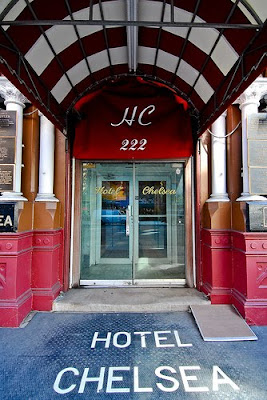
It is not the sort of reverent place that jumps out at you the same way St. Paul's Cathedral in London or Notre Dame in Paris might. Just this past summer I took an old pal of mine there as part of an organic tour of Manhattan. Being an informed Bob Dylan fan (whose own lyrics apprise "Sad Eyed Lady of the Lowlands" was written in Room 211 of the hotel in 1966), my friend was quite familiar with Lady Chelsea's muse-like allure. His reaction upon meeting her was as Dylan'esque as I could have hoped for. Standing on the large self-titled mat lying outside her lobby door, Sal (my friend) nodded and grinned in silence as if meeting a longtime lover for the first time. He looked into her windows the way a lost sailor looks into the eyes of a prostitute--so much misplaced hope, so much gracefully aged beauty, so much heart-ached wisdom. I could hear Sal’s thoughts as he debated entry outside her lobby doors:

"My warehouse eyes, my Arabian drums. Should I leave them by your gate? Or sad-eyed lady, should I wait?"

The legend of Chelsea exceeds just American rock music lore. This also happens to be the hotel where many of the Titanic survivors stayed after the Carpathia arrived at New York's Pier 54 on April 18th, 1914. Poet Dylan Thomas died in Room 205 on November 9, 1953 after drinking "eighteen straight whiskeys" at the nearby Whitehorse Tavern on 8th Avenue and Sir Arthur C. Clarke penned 2001: A Space Odyssey in Room 328 in 1968. Other famous literary residents include many of the founding fathers of the Beat Generation: Herbert Huncke, Gregory Corso, Allen Ginsberg, Jack Kerouac and William Burroughs, who wrote his famous Naked Lunch while in residence, to name a few. Mark Twain, Thomas Wolfe, Arthur Miller and Leonard Cohen also all lived, at one point or another, inside the walls of the Chelsea Hotel. The hallways are penned with genius; the corridors scribed with the suffering only a writer knows.

“Who among them can think he can outguess you?”

The music-list almost supersedes the literary one. Bob Dylan was not the only sixties icon to have lived there. The list also includes Janis Joplin, Jimi Hendrix, The Grateful Dead, Joni Mitchell, and Canned Heat. In the seventies it was Patti Smith, Dee Dee Ramone, Alice Cooper, Rufus Wainwright, and Tom Waits. More recently, Madonna shot her infamous pictorial essay book Sex in Room 822 (1992) and indie rocker Ryan Adams wrote and recorded his album Love Is Hell while living there in 2004. Without doubt, the most famous music legend to come from the bowels of Hotel Chelsea is that of Nancy Spungen, who was found stabbed to death in the bathroom of Room 110 on October 12, 1978. Boyfriend and Sex Pistols front man Sid Vicious was charged with the murder, but conspiracy theories still roam on whether he committed the act or not. In a semi-conscious coma of heroin and hydromorphone, Vicious wavered back and forth from confession to exoneration about the events that night; sometimes blaming himself and other times blaming a coke dealer. He committed suicide before his trial for murder began and to this day punk diehards sneak into the hotel to leave needles, roaches, dime bags, and bottles outside where Room 110 would be if it remained in tact (management had the room destroyed and split in two sometime in the eighties in an attempt to end the unwanted shrine).

“But why did they pick you to sympathize with their side?”

It pains me to see Lady Chelsea up for sale. A prostitute she has always been; but never a whore. I find some sort of romantic nobility in the classy working girl playing matron-host to subterranean denizens. Lady Chelsea has existed for over a century now as a den mother to the rejected souls this city eats up and spits out. Few have gone on to make it; most have died in the gutter. But none of her vagrants ever compromised their will or amputated their spirit in exchange for wealth. As Chelsea is forced to list herself in Real Estate magazines where only the Hilton’s, Sheraton’s and W’s shop, I can’t help but feel saddened for this once anti-glamorous factory girl. It’s like watching the paragon of sub-society be forced to serve up Appletinis and host corporate conventions for mutual fund managers and investment bankers. You can already see the defeat in her eyes. The lobby that once inspired the Velvet Underground to write, “Her perfect loves don’t last / Her future died in someone’s past / Here they come now / See them run now / Here they come now / Chelsea Girls” risks being leased out for an on-location episode of The Real Housewives of New York City. It makes me fucking vomit.

“Oh, who among them do you think could destroy you?”

Wednesday, October 27, 2010

Jay-Z: Paragon for the 'American Dream' or Corporate Puppet?

Jay-Z was featured on the cover of Forbes Magazine last month alongside investor genius/billionaire Warren Buffet. What does this have to say about the authenticity of hip hop? Is Jay-Z a prime representation of the American dream; or is this just another example of an African American subcultural movement falling victim to white hegemony and corporate America capitalization? This week in Liner Notes, I attempt to offer both sides of the argument and leave you, as reader, to come to your own conclusions on the matter. The basic question I want you to think about is whether or not Jay-Z is an example of the richness and possibility of the rags-to-riches­ “American Dream” model, or if he is proof that all art is for sale, and success in America will inevitably lead to exploitation and appropriation.

The question of ‘authenticity’ is what really lies at the center of this debate. At what point does an artist’s work cease to be authentic? Perhaps the more important question is: Who is the authoritative voice that gets to decide? Mixed opinion on the arch of Jay-Z’s career goes without saying. There are some fans who feel he has grown, matured, and improved with age; while others believe that as Jay-Z’s success and popularity rose to the top, his music sank to the bottom.

Many hip hop fans with whom I have spoken (and who, I might add, have much more knowledge on the topic than I do) argue that Jay-Z has ‘sold-out.’ Being called a ‘sell-out’ is a pop culture phrasing no artist ever wants to hear. A brief look through American music and popular culture history tells a different story. Bob Dylan was called a ‘sell-out’ when, in 1965, he went from protest-poet laureate to the folk revivalists to rock ‘n roll star with a five-piece electric backing band. Years later, Dylan fans around the world acknowledge this change as perhaps the greatest moment of his career and rock scholars synonymously recognize it to be one of the most successful and profitable (in terms of talent and career-direction) transformations in the history of American music. So if the root of ‘authenticity’ lies within public opinion, which I think it does, then the verdict is still out on whether Jay-Z is a continuing success or not.

There can be no argument that Jay-Z is beyond successful when speaking in terms of financial gain and world-recognition. Shawn Carter (aka Jay-Z) was born in the projects of Bedford-Stuyvesant’s Marcy Houses (located in Brooklyn, New York) where as a young teen he reportedly shot his brother for stealing from him and was a self-proclaimed crack-cocaine dealer. Now, Carter is the CEO of a multi-million, multi-faceted corporation known as Roc Nation, which includes entities such as Roc-A-Fella Records, Rocawear, and many other profit and non-profit organizations. Answers.com reports Carter’s January 2010 net worth to be greater than $785 million. Couple that with his wife’s, Beyoncé Knowles, net worth of $461 million (also sourced from Answers.com) and you get a total family worth of $1.246 billion. From a business standpoint and social upward-mobility point of view, there is no arguing that Jay-Z falls under the category of “success.” But what about his music? Has it suffered or flourished for this wealth and fame?

Jay-Z’s most recent album (The Blueprint 3) was also, by all accounts, a massive success. Independently, the single “Empire State of Mind” stayed in the number one spot for five consecutive weeks on Billboard’s Hot 100, and the overall LP was number one on Canadian, UK, and U.S. R&B, Rap & Hip Hop, and Pop album charts when it debuted in 2009. Had Jay-Z turned pop? And if so, how did the hip hop nation feel about it?

The question I pose to the reader is whether Jay-Z’s overcoming social-class oppression is an example of what is possible in 2010 America, or a one-off exception to the rule. Some may argue that Jay-Z is not a success at all, but has only become a corporate puppet. This argument carries the logic that success isn’t about sitting in a three-piece suit next to Warren Buffet on Forbes TV; it is more about recognizing the unjust disparities in this nation between the rich and the poor and seeking to bridge the gap--something Jay-Z has yet to do. To those coming at the debate from this side of the line, Jay-Z is not seen as a symbol of social upward mobility at all; instead he has become an agent of capitalist appropriation and a puppet to help sell the myth that anyone in this country can “make it.” I would expect then, that those people who feel this way could care less for “hip-pop.”

I don’t know where I stand in the debate. One of the common complaints about my editorials posted weekly is that I never offer my reader my stance on the cultural debates I present. I have been accused by some of asking the questions and then wavering, or just plain omitting, which side of the fence I stand on. Therefore, in order to appease those readers who would prefer I act more Bill O’Reilly’esque in the question of whether Jay-Z is an example of success from the streets of a tough neighborhood, I would have to disagree with anyone who contends that he is not, and argue that he is. Although I understand the point and idealism of re-structuring the measures by which we gage success, I guess I am more optimistic about the possibilities a democratic state has to offer, as imperfect as it is. Seeing Jay-Z being interviewed alongside Warren Buffet in a $15,000 suit and knowing his background brings a smile to my face; not disgust. And to think that the man did this on the back of hip hop beats and witty rap lyrics further supports my feeling that so much is possible if one is just willing to look inward as opposed to living a life with no mirror.


Wednesday, October 20, 2010

The King & The Jester


While doing some research for this week’s Liner Notes I came across an interesting article on a blog I used to write for called Dog On A Root. Author Jim Young has recently written a convincing argument venting his frustrations on Elvis Presley’s undeserved designation as “The King of rock ‘n roll.” While I find myself disagreeing with Jim’s point of view on most of the topics he decides to discuss on Dog On A Root, I must admit that his position on Presley’s misnomer is one with which I am in agreement. I have written a lot on the foundations of Hip Hop and Indie recently, and have not discussed the roots of rock ‘n roll in quite some time. Using Young’s article, titled Dethroning The King of rock ‘n roll, I want to add my thoughts on how Elvis came to be recognized as the “King,” what injustices this delivers to some of the other contributors in the shift of American music that took place in the late forties and early fifties, and how the problem lies in the assumed notion of the term rather than the term itself.

Young starts off his article with a very valid question: “Can someone please explain to me how Elvis was ever crowned the King of rock ‘n roll?” While my answer can be argued from many different angles, the best response I can provide to this very open-ended question is this: “Elvis earned such a title as a result of appearing in the public eye at a time when America was desperate to invent their own unique and independent national identity.”

In the years immediately following World War II, the U.S. found themselves suddenly at the centre of a transforming global culture. This gave rise to a very important question in need of an equally important response: ‘What does it mean to be American?’ For a country that had been quickly projected into the cultural spotlight, and who had yet to come to terms with its own racial politics, Elvis Presley provided the perfect iconic spokesperson—an all-American country boy, with good-looks and small-town charm, and yet who embodied the gusto to perform country and rhythm ‘n blues music with African American swagger. This combination of a white American hero in touch with his fetishization for African American subcultural gave voice and image to the new American identity—in my opinion, an image that still very much exists today (look at Eminem and The Black Keys as examples).

I feel Young’s re-designation of Presley to ‘court jester’ is an accurate and intelligent one. I agree with the reassignment and explanation he provides to his reader: “Not unlike a court jester, Elvis was a GREAT entertainer with a GREAT voice.” However, I feel Young goes too far when he remarks, “[b]ut let’s face it. [sic] That’s all he was and that’s all he contributed to rock ‘n roll.”

Elvis offered more to rock ‘n roll and the American identity than pure entertaining and smooth vocals. Following this logic, one could have a substantial argument for over 90 percent of rock ‘n roll legends offering nothing more to American culture than ‘entertainment.’ If Young is saying that Presley wasn’t “innovative” enough to earn the handle “King” (which is what I think he is saying), his argument weakens. I agree that Elvis lacked innovativeness and originality, but not all Kings are necessarily inventive or groundbreaking; nor do they have to be. What they are responsible for is the leadership of their subjects. Therefore, it is not so much that Elvis being labeled as “King of rock ‘n roll” is a misnomer as it is how the public interprets what this moniker means.

People too easily associate Elvis Presley as the King of rock ‘n roll to mean that he invented it. This is the crux of Young’s argument; the beef he has with the term and the common understanding of the term’s meaning. Young feels “[t]here are many other much more deserving contenders for the crown of King of rock ‘n roll such as Jerry Lee Lewis, Carl Perkins, and of course Chuck Berry.” I think he is right; I just have a problem with his language. What I argue is that there are many “more deserving contenders” who should be identified as the innovators of rock ‘n roll ahead of Elvis—and the artists Young names is a great place to start. So while we agree in the base principal of the notion, it is the terminology Young resists, whereas it is the public’s perceived association of what the term means to which I resist. In other words: I am fine with calling him “King”; I am not okay with what most people think “King” to mean.

As ‘King,’ Elvis Presley brought African American rhythm and blues to white audiences across the country; he pushed the envelope of acceptability on prime-time radio and in mainstream television and performance; and he helped to secure the mythology of the postcolonial American identity. In short, he “delivered the message to his subjects” and the whole world bought in. However, like Young, I agree that he was a mere “spokesperson for the composers of his songs;” he was adorned a crown not based on his achievements; and he was merely a “performer” with a message unwritten by him but by the African American and country and western subcultures that made up the cultural landscape from which he came (namely Tupelo, Mississippi and Memphis, Tennessee).

Young ends his article requesting that Chuck Berry reclaim the crown that is rightfully his. I cannot emphasize enough my agreement with Young’s frustration and sentiments that Presley receives all the attention of ‘King’ while performers like Bo Diddley, Chuck Berry, Ike Turner, Jerry Lee Lewis, and Roy Brown (only to name a few) for the most part go unnoticed. I only feel that rather than transpose the crown, let us focus on exposing the other members of court as more influential than the man whose face gets painted on the royal portrait. I know Jim Young personally, and I therefore expect him to agree with me when I pose the notion that King and Jester are interchangeable terms.

I guess when it’s all said and done, I am actually doing a terrible job of responding to the article because what I am really doing is answering the question with a question: Are all Kings not really mere court jesters of their own monarchy anyhow?